
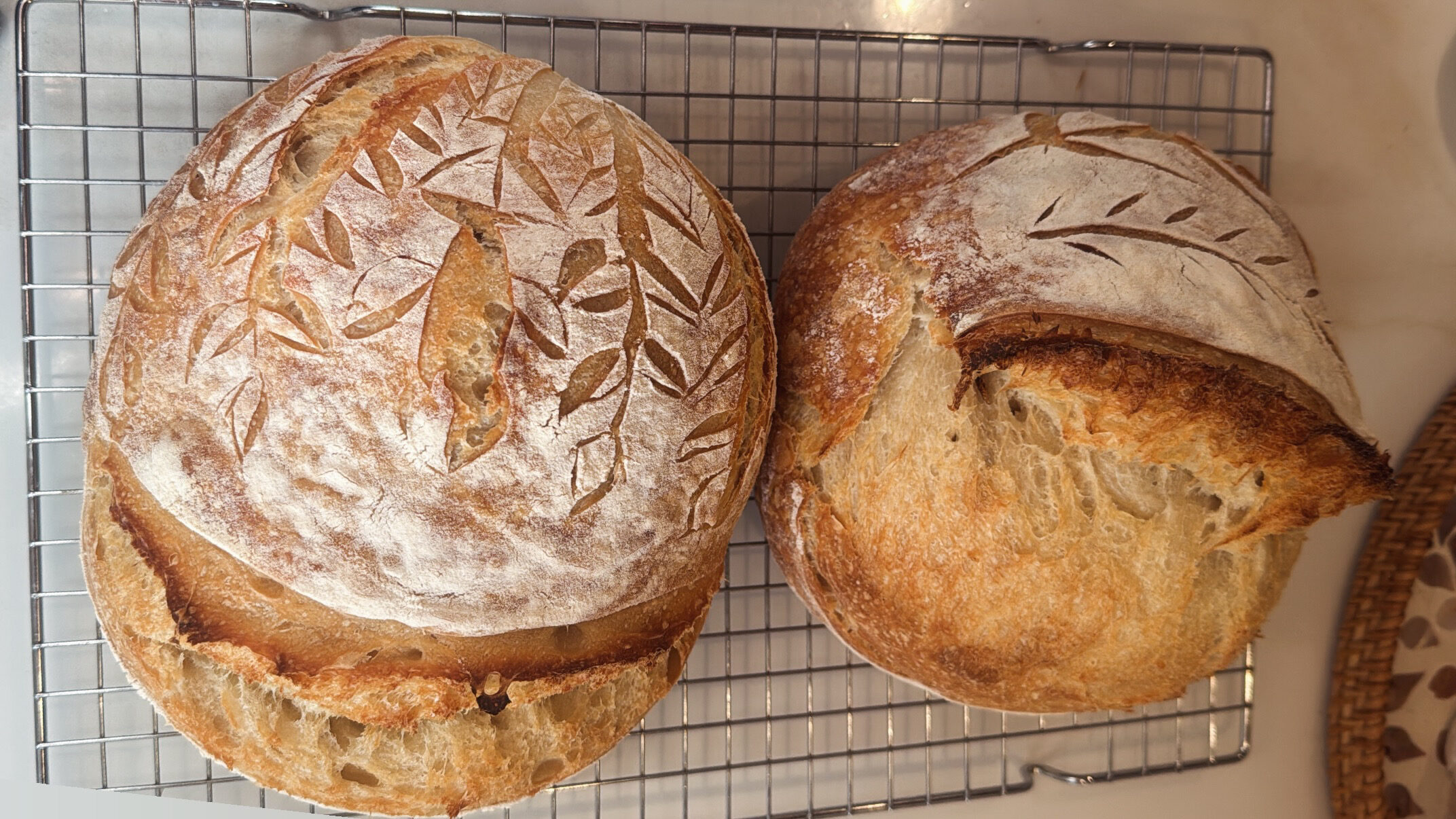
This is my tried-and-true artisan sourdough loaf. No complicated steps. No perfection required. No weighing your flour like you’re in a lab (okay fine, we are weighing it — but relax).
And let me just say this now:
Going a few grams over will not ruin your bread. Try your best, but we are not defusing a bomb.
Ingredients
- 100g active sourdough starter
- 520g unbleached bread flour
- 360g spring water (DO NOT USE TAP!!!)
- 13g salt
That’s it. Four ingredients. No yeast packets. No mystery additives. Just the basics — the way bread was meant to be.
Step 1: Mix Water + Starter
Combine your water and starter and whisk until mostly combined.
There may be floating chunks. We are not aiming for a smoothie here. It’s fine.
Step 2: Add Flour + Salt (Hands Required)
Add your flour and salt.
Now get your hands in there. Yes, hands. I am way too impatient to gently mix with a spoon. We’re making bread, not frosting.
Mix until no dry flour remains. You’ll have a shaggy, messy dough. Perfect.
Let it sit for 30 minutes, covered with tea towel (or I like shower caps)
(This is when I like to clean up my counter and kitchen scale because flour somehow ends up everywhere.)
Step 3: Stretch and Folds
After 30 minutes:
- Wet your hand
- Grab one side of the dough
- Stretch it up as far as you can without ripping
- Fold it over itself
Rotate the bowl and repeat until you’ve gone around about 4 times.
That’s one set.
Step 4: Repeat
Repeat stretch and folds 3 more times — every 30 minutes — for a total of 4 rounds. Covering in-between.
Now let me be honest: this is what I try to do.
I absolutely forget sometimes and go an hour between rounds. It’s fine. Sourdough is forgiving. It is not that serious.
Step 5: Bulk Ferment (AKA The Waiting Game)
This is the hardest part for me. It’s mostly just… waiting.
I bulk ferment for about 8–12 hours because I keep my house cold, so over-fermenting isn’t usually an issue.
If your house is warmer, start checking around 6–8 hours.
Signs it’s ready:
- It looks puffier
- It has bubbles
- It jiggles slightly when you shake the bowl
And honestly? If you’re unsure, ask ChatGPT. Random dough pictures are basically my entire ChatGPT history.
Step 6: Shape the Dough
After bulk fermentation:
- Gently turn your dough onto a lightly floured surface.
- Stretch it into a rough rectangle.
- Fold in the sides and roll it up like a burrito.
- Use your hands to gently drag it toward you on the counter to create surface tension.
You want the top to look smooth and tight — even if the bottom is a little chaotic. Pinch it closed underneath if needed.
Rustic is welcome here.
Step 7: Cold Ferment
Place your shaped dough into a linen-lined basket (or a bowl with a well-floured towel). Clean up that messy bottom if needed.
Put it in the fridge for 12–72 hours.
I usually prefer 24–36 hours.
- Longer = more sour flavor (which I love)
- Too long = risk of overproofing and a flatter loaf
It’s a balance. But again — not that serious.
Step 8: Preheat Everything
Near the end of your cold proof:
- Preheat oven to 450°F
- Place your Dutch oven inside and let it preheat for about 30 minutes
A hot Dutch oven = better oven spring.
Step 9: Flip + Score
Keep the Dutch oven in the oven while you:
- Take your dough out of the fridge
- Flip it onto parchment or a silicone mat
- Score it with a sharp knife or razor
One confident slash. Don’t be timid. Bread respects confidence.
Step 10: Into the Dutch Oven
Carefully remove the Dutch oven.
I like to sprinkle a little rice on the bottom for a slightly softer crust.
Place the dough inside. Lid on. Back into the oven.
Step 11: Bake
Bake for 45–55 minutes with the lid on.
If you want a crunchier crust, remove the lid for the last 10 minutes.
Internal temp should be 200–210°F.
Step 12: The Hardest Step — Waiting
Remove from the Dutch oven and place on a cooling rack.
Wait about 2 hours before slicing.
Now… I know.
If you’re impatient and slice it early, I’m not judging you. I’ve done it. Multiple times. I haven’t noticed a life-changing difference.
It’s bread. Not a personality test.
Enjoy
Slice it. Slather it with butter. Make a sandwich. Eat it plain standing at the counter.
And if you’re looking for more sourdough ideas — sandwich loaves, discard recipes, bagels — check out the rest of my sourdough recipes on my page.
Your starter deserves a full-time job.
Items I use:
- Ultimate Starter Kit– The exact one I bought is no longer available but this is one looks to be the most extensive at the best price
- Dutch Oven– My tried and true
- Glass Mixing Bowl– I love a Glass Bowl to see my Bubbles
- Proofing Baskets– These are my favorite but there are some in the “starter kit” if you buy that instead
- Food Thermometer– Sourdough is too much work to cut into raw bread. Temp that ish
- Kitchen Scale– A must for any baking, stop using cups. There is one in the “starter kit” if you buy that instead
- Silicone Baking Mat– This is the one I have but there is one in the “starter kit” if you buy that instead.
- Shower Caps– to cover my dough while proofing, I also use these on my room temperature starter (use a real lid for the fridge)
- Cake Stand– This is honestly how I store my bread to keep it freshest
- Bread Bags– For Gifting to Friends and Family
Method
- Mix Water + Starter
- Add Flour + Salt
- Stretch and Folds (Round 1)
- Repeat Stretch & Folds
- Bulk Fermentation
- Shape Dough
- Cold Ferment
- Preheat Oven
- Preheat Dutch Oven
- Score Dough
- Bake
- Cool
- Slice & Enjoy
